

Ocean Pals learning resources
Plastic Pollution – Ocean Solution: classroom lessons
A wrapper dropped on a street can begin a journey no one intended. Investigate how plastic can reach the ocean, explore ways to interrupt its journey and turn an idea for change into artwork. This learning unit includes lessons for Grades K–2, 3–5, 6–8 and 9–12. Choose the lesson that suits your students. Each includes a printable student handout with space to investigate, draw and explain.
Before the lesson
Using these lessons
Choosing a lesson level compares the four grade divisions and suggests ways to adapt the support for your group.
Students investigate how an object can become litter and explain an action that could keep it out of water. By the end, look for a plausible route, a clear connection between an action and its effect, and an artwork explanation that uses what students learned.
Grades K–2 follow a story and explain a helpful change. Grades 3–5 trace a route and identify where to act. Grades 6–8 compare actions and interpret observations; Grades 9–12 evaluate a claim and plan how to test a recommendation.
Have pencils, drawing paper and coloring materials ready, with the matching handout per child or pair. Grades 9–12 may also use calculators. Read evidence passages aloud if helpful; students may explain their ideas aloud while an adult records their words. Allow another session for finished artwork.
Student handouts
Each handout follows its lesson sequence, with room for drawings, explanations and revisions. The two younger groups use one page each; the two older groups use two pages each.
Grades K–2 student pageGrades 3–5 student page
Grades 6–8 student handout
Grades 9–12 student handout
Keep the materials safe. Use drawings or clean examples supplied by an adult. Students do not need to collect litter. Do not use sharp items, discarded line or unknown containers, or release plastic pieces into water for a demonstration.
Grades K–2 · 35 minutes
Where could the wrapper go?
Students describe a possible movement of litter and explain how a person could interrupt it. Listen for a connection between the change they draw and what happens to the wrapper. Read the story and handout prompts aloud; drawing, pointing and speaking are enough.
Notice the shapes 5 minutes
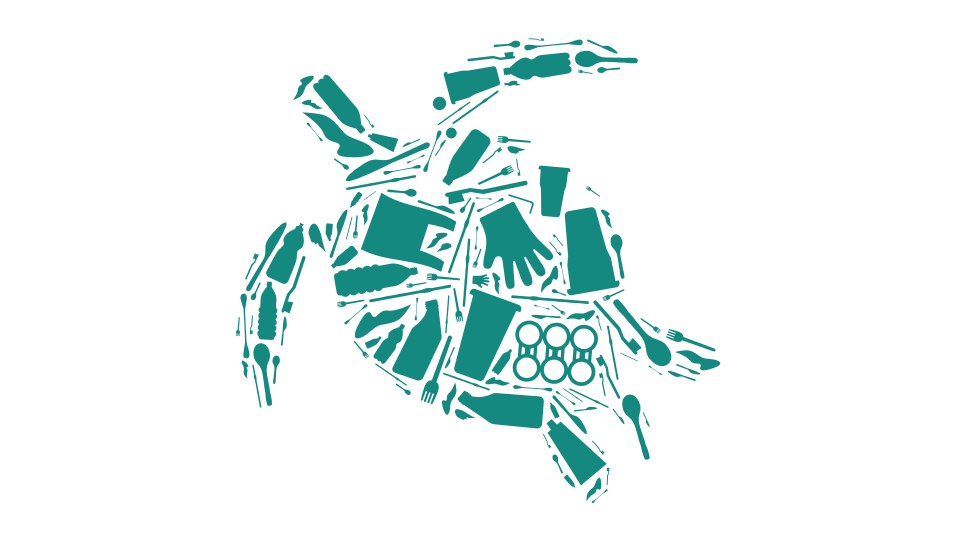
Show the turtle. Let children name the animal and point to familiar objects inside its outline. Explain that an artist arranged these shapes to make a picture. It is not a photograph of things inside a turtle. Ask, “Where have you seen a wrapper or a bottle being used?”
Tell a wrapper story 8 minutes
Read aloud
A wrapper lies on a path near a stream. Wind blows it along the path. Rain could wash it into the water. But an adult might collect it first. What could happen next?
Background: UNEP on rivers.
Draw a path, a wrapper and a stream on the board. Invite a child to trace a possible movement with a finger. Then show a second ending where an adult collects the wrapper. Explain “litter” as waste left loose in a place where it does not belong. Children draw one possible journey in the first box on their handout. They need not copy a detailed scene.
Choose a helpful change 7 minutes
Ask, “What could help keep the wrapper out of the stream?” Discuss putting a used wrapper into the right bin and asking an adult for help when a bin is full. Explain that adults must arrange for bins to be emptied. Moving a wrapper behind a bush leaves it loose; ask what might happen when wind or rain arrives.
Keep responsibility shared: children can ask for help, and adults manage collection and safe disposal. Do not ask children to pick up unknown litter.
Draw another ending 10 minutes
In the second box, children draw a change that could keep the wrapper out of water. Ask them to show a person or action as well as the place. Invite them to include an animal that needs the water. They can tell an adult, “This helps because…” while the adult writes their words.
Tell, change and try again 5 minutes
Partners point to what changed between the pictures. Ask each child to add a detail if the action is hard to see. Then offer a new example aloud: “A bag is loose beside a pond, and the bin is full. What could you ask an adult to do? Why?” Listen for a reason connected to keeping loose litter away from water.
Use the Grades K–2 handout
Two drawing spaces support the story and a changed ending. An adult can read the prompts and record the child's explanation.
Open the printable student pageGrades 3–5 · 45 minutes
Where could we change the journey?
Look closely 5 minutes
Show the turtle illustration. Ask students to name objects they recognize, then describe the animal they form. Ask: “What message might the artist want us to think about?” Accept different interpretations supported by details in the image.
Separate the picture’s message from evidence about the world. The turtle is an artistic arrangement. It does not show what one real turtle swallowed or prove how often animals encounter litter.
Follow a possible route 10 minutes
Read together: from land to water
Rain and wind can move loose litter. A wrapper left on a street might wash into a drain and then reach a stream or river. Some rivers carry litter toward the sea. Litter can also stay on land, get caught along the way or be collected. The route depends on the place.
In water, animals can swallow plastic or become tangled in it. Some plastic floats and some sinks. Plastic can break into smaller pieces that are still plastic.
Sources: UNEP on rivers and NOAA on ocean plastics.
On the student page, draw arrows from a street to water. Label what could move the wrapper. Add a place it might stop before reaching the sea. Partners should explain why their route is possible, rather than saying every wrapper follows it.
Ask: “Would being far from the coast always keep litter out of the ocean?” Use the river connection to explore the question. Check local drainage information before presenting this example as your school’s actual route.
Choose where to act 10 minutes
Read together: more than one place to help
People can reduce unnecessary packaging, use suitable containers again and improve how waste is collected. Recycling can help where the material is accepted and processed. It cannot solve plastic pollution on its own. Schools, businesses and local services can help change what happens before an item becomes litter.
Source: UNEP on preventing plastic pollution.
Compare three choices: a school reduces unnecessary wrapping; a family uses a suitable container repeatedly; a local service collects waste before bins overflow. For each, ask who can act, where it changes the journey and what it does not fix.
Students mark where their action could help: before an item becomes litter, or at a later point on the route. Write or explain what changes beside that point. Encourage a reason: “This could help because…” More than one choice can be useful. Avoid presenting a purchase as something every family must make.
Make the action visible 15 minutes
Students sketch an animal and show one action that could help keep plastic out of its habitat. The image should connect the action to the journey they investigated. Arrows, a before-and-after scene or a short caption can make that connection clear.
They may invent their own arrangement of drawn objects or paper shapes. Ask them to develop their own image rather than trace the example turtle. A collage communicates an idea; making one does not itself prevent litter from reaching water.
Explain and revise 5 minutes
Partners explain their images. The listener asks, “Where does your action change the journey?” Each student then adds or changes one detail to make the explanation clearer.
Check understanding with a new example: an overflowing bin beside a stream. Ask students to suggest an action and explain why it fits. Listen for reasoning they can transfer to this situation.
Grades 6–8 · 55 minutes
Which action could make a difference?
Students compare two interventions, distinguish an observation from an explanation, and create a visual message with a defensible claim. Look for a stated mechanism, evidence used within its limits, and a revision that improves the claim.
Read the image 5 minutes
Show the turtle and ask pairs to separate what they can observe from what they infer. “The artist used bottle shapes” is an observation. “These bottles were found inside a turtle” is an unsupported inference. Ask what a viewer might mistakenly conclude from an environmental image.
Map the system 10 minutes
Read together: a route with branches
Plastic may move through streets, drains and rivers, but it can also collect on land or along waterways. A count at one place captures only part of that journey. Preventing unnecessary waste, reusing suitable items and improving collection act at different points. No single action addresses every source.
Sources: UNEP on rivers and UNEP on prevention.
Sketch a route from a school snack area toward water. Include collection and retention as branches. Mark where reducing unnecessary wrapping could act, then where covered bins and reliable collection could act. Identify who would need to carry out each action and one practical constraint, such as food protection, cost or collection capacity.
Test a claim against observations 15 minutes
A fictional school investigation
Students count visible wrappers in the same marked area after lunch on four days. Covered bins are introduced after day 2. These numbers are invented for discussion; they are not findings about a real school.
| Day | Bins | Count |
|---|---|---|
| 1 | Open | 32 |
| 2 | Open | 28 |
| 3 | Covered | 18 |
| 4 | Covered | 20 |
Find the mean before and after the change: add the counts in each pair and divide by two. Then write one statement the counts support. Compare “In this fictional investigation, fewer wrappers were counted after the bins changed” with “Covered bins prevented plastic from reaching the ocean.” What would the second claim require that these observations do not provide?
Ask what else might change the count: wind, rain, attendance, the snacks served, or cleaning before the count. Choose one factor to record and one way to make a follow-up comparison fairer. Do not ask students to handle litter or enter drains or waterways.
Choose an action and communicate it 15 minutes
Compare reducing unnecessary wrapping with improving bins and collection. On the handout, record who acts, why each could help and one limitation. Recommend an action or a justified combination. Acknowledge what the counts have not tested.
Plan an artwork with a short claim and a caption explaining the mechanism. Students may use a route, contrasting scenes or an animal made from their own drawn objects. Keep observations and predictions distinguishable. If using these counts, label them “Fictional school investigation”; do not present them as measurements from your school. A sketch and explanation are enough for this session.
Challenge and revise 10 minutes
Exchange sketches. The reviewer identifies the claim, checks its evidence and asks one question about its limits. Students revise the image or caption and explain why. For an exit response, introduce a new situation: the bins stay covered but collection is missed for three days. Would their recommendation still work? What should change?
Use the Grades 6–8 handout
Page 1 contains the fictional counts and action comparison. Page 2 provides room for an artwork plan, its claim and a revision.
Open the printable handoutGrades 9–12 · Two 45-minute sessions
What would count as a solution?
Students evaluate a public claim, compare actions across the life of a product and propose a way to check whether an intervention helps. Look for a defined outcome, a fair comparison, explicit uncertainty and a visual message that accurately represents the evidence.
Define the problem Session 1 · 10 minutes
Show the turtle illustration. Ask what it communicates and what it cannot establish. Groups choose a more precise outcome than “save the ocean”: for example, less unnecessary packaging used, fewer loose wrappers at school, or less litter entering a local stream. Discuss why measuring one does not automatically measure the others.
Read together: consider the whole journey
Plastic pollution can be addressed through product design, reduced unnecessary use, suitable reuse systems and better waste management. Changing a material also changes how it is made, used and discarded. Rivers can transport plastic, but also retain it. A measurement at one point does not describe the whole system.
Sources: UNEP on a life-cycle approach and UNEP on rivers.
Interrogate the headline Session 1 · 15 minutes
A fictional comparison
Two school areas are observed over five days before and five days after Area A receives covered bins. Area B keeps its open bins. Wrappers are counted and cleared by adults at the same time each day. The table gives totals; individual daily results and weather records are unavailable. All numbers are invented for this lesson.
| Area / period | Wrappers counted | Snack servings |
|---|---|---|
| A / before | 40 | 200 |
| A / after | 18 | 120 |
| B / before | 30 | 150 |
| B / after | 24 | 160 |
A draft headline reads: “New bins cut ocean plastic by 55%.”
Find the percentage fall in Area A's raw count: (before − after) ÷ before × 100. Then calculate wrappers per 100 snack servings in each row: wrappers ÷ servings × 100. How does Area B change your interpretation? The ratio is a way to compare counts with activity; it is not proof that every wrapper came from a counted snack.
Rewrite the headline to reflect what was measured. Explain why neither the raw count nor the adjusted comparison measures ocean plastic or isolates the effect of the bins.
Compare actions and trade-offs Session 1 · 20 minutes
Compare reducing unnecessary wrapping with improving bins and collection. For each, identify where it acts, who controls the change, what must be in place and a possible burden. Consider food protection, affordable access, staff time and the reliability of collection. A reuse proposal also needs a workable return and cleaning system.
Use the handout to recommend one action or a combination. Distinguish the general mechanism supported by the source reading from local assumptions that still need checking. The fictional bin comparison does not test packaging reduction. Avoid assigning a numerical benefit to an untested option.
Plan a useful check Session 2 · 10 minutes
Choose an outcome close enough to the proposed action to measure. Describe what adults would record, where and when, a comparable area or period, and one important factor to track. Explain what finding would make the group revise its recommendation. A safe classroom plan is sufficient; conducting a waste audit is not required.
Discuss how totals hide day-to-day variation. Would further observations, records of wind and cleaning, and comparable snack provision make the comparison more informative? They would still need careful interpretation.
Make an evidence-based visual argument Session 2 · 20 minutes
Create a sketch for a school audience with a recommendation, an explanation of how it could help, and a caption stating an evidence limit. Use a route, a clearly labeled comparison or original object-based artwork. Label fictional data if using it. Do not depict invented results as a real school's success.
Partners check whether the image promises more than the words support. Does a larger animal imply a measured population gain? Does an arrow imply a route nobody has checked? Revise the image and caption together.
Defend and revise Session 2 · 15 minutes
Present the recommendation and measurement plan to another group. Each listener asks about one assumption or practical burden. Record a revision and its reason. Finish with a new situation: the next month shows fewer wrappers on the school grounds but more beside the collection point. Does that establish success? Explain what to investigate before repeating the claim.
Use the Grades 9–12 handout
Page 1 supports the comparison and action choice. Page 2 supports the evaluation plan, visual argument and revision.
Open the printable handoutFor educators
Discussion guidance
A useful explanation connects the object, a route and an action. For example: “Rain could wash the wrapper into the stream. Keeping the bin from overflowing could stop loose wrappers getting out.” This is one possible response, not a sentence students need to memorize.
- “We should recycle everything.”
- Ask which materials the local service accepts. Then ask what could change before an item needs disposal. Keep the difference between possible recycling and actual collection clear.
- “All plastic ends up in the sea.”
- Return to the branching route. An item might be collected or caught elsewhere. Explain why the class used “could” and “might.”
- “Paper is always better.”
- Ask what the item must do and whether an existing item can be used again. A different material still needs resources to make and a plan for its use and disposal.
- “We made a picture, so we fixed the problem.”
- Distinguish explaining an action from carrying it out. Ask what a school, family, business or local service would actually need to do.
For students who need help writing, use “The object could…” and “Our action could help because…” as optional sentence starters. For an extension, compare two actions and explain what each leaves unresolved. Assess the explanation and revision, rather than drawing skill.
Grades K–2: listen to the explanation
A child might point to a bin and say, “The wrapper stays here so the wind cannot blow it into the stream.” Ask who empties the bin to see whether the explanation extends beyond the picture. A child who asks an adult for help with a full bin has identified a useful action. Naming every object or writing a sentence independently is unnecessary.
For kindergarten, draw the story together and let children focus on the changed ending. Older children can add arrows and a spoken or written reason. If a child hides litter behind a bush, revisit what wind could do. In the pond example, listen for an adult arranging safe collection rather than a child handling unknown waste. A clear oral explanation can demonstrate understanding even when a drawing is unfinished.
Grades 6–8: interpreting the investigation
The means are 30 wrappers before and 19 after, a difference of 11 in this fictional sample. Fewer observed wrappers after the change supports a description of these four counts. It does not establish that the bins caused the difference or measure plastic reaching the ocean. If arithmetic would obscure the discussion, provide the means and ask students to interpret them.
A useful follow-up could compare similar areas on the same days, keep the count time and method consistent, and record weather, attendance and cleaning. More observations would help assess whether the pattern persists; they would not automatically establish causation. An intervention recommendation may still be reasonable if students explain its mechanism and uncertainty.
In the missed-collection example, covered bins alone may be insufficient. Students might revise their plan to include reliable collection or less unnecessary packaging. Accept different choices when the reasoning addresses the situation. Oral explanations and partner diagrams can show understanding without a polished written argument.
Grades 9–12: interpreting a comparison
Area A's raw count falls by 55%, from 40 to 18. Counts per 100 snack servings fall from 20 to 15 in both areas, a relative decrease of 25% in each. The comparison shows no additional decline for Area A on this measure. It neither establishes a benefit from the bins nor proves they have no effect. The areas may differ in other ways, the daily variation is unknown, and snack servings do not identify the source of every wrapper.
A defensible caption could say, “In this fictional investigation, wrappers counted per 100 snack servings fell from 20 to 15 in both areas; the bin change's contribution is unclear.” Do not turn the ratio into a claim that 15% of snack wrappers became litter. No measurement here establishes an ocean outcome.
If calculations consume the discussion time, provide the four ratios and ask students to explain the comparison. For an extension, ask what daily records would reveal that aggregated totals cannot. Useful evaluation plans name an outcome, a consistent method, a comparison, a factor such as weather to record, and a result that would prompt revision. They should consider who carries the work and cost.
In the collection-point example, pollution may have moved rather than decreased, or a separate problem may have appeared. Students should seek comparable counts across both locations and check the collection process. Reward a qualified explanation and a useful next observation. A confident success claim is not justified by the school-ground count alone.
Evidence behind the lesson
Sources for educators
- UNEP: Riverine plastic pollution — how rivers transport plastic and where prevention and collection can help.
- NOAA: A guide to plastic in the ocean — movement, fragmentation and effects on marine life.
- UNEP: What is the life-cycle approach? — reduction, reuse and waste management as parts of a wider response.