

Ocean Pals learning resources
Rays in Their World: classroom lessons
Rays live and feed in different ways. Compare a giant manta ray with a southern stingray, then use observation, source evidence and artwork to show what makes each animal distinct. Choose a teaching sequence for Grades K–2, 3–5, 6–8 or 9–12.
Before the lesson
Using these lessons
Choosing a lesson level compares the four grade divisions and suggests ways to adapt the support for your group.
Each grade division has a different task. Younger students compare how two rays find food. Older students examine what evidence about one species can—and cannot—tell them about rays as a group. All four sequences end with an explanation expressed through artwork.
Show students accurately labeled animal images, and identify what can be observed directly versus what is learned from a source. Read the shorter source cards aloud when useful. Students may explain an idea orally or dictate a caption; drawing skill is not the science assessment.
Students use the artwork to explain a finding, not to substitute for observing an animal or reading a source.
Student handouts
Open the matching printable page and use its Print button. Students may speak or dictate an explanation instead of writing. Separate drawing paper is also suitable.
Reference photographs for comparison
Before class, open the following photographs on their source pages. Show them together or alternate between them, keeping the animal names visible. Describe the visible features aloud. A still picture does not establish an animal's diet or population trend. These links are for viewing the source pages; follow the owners’ terms before making copies.
- Giant manta ray: NOAA’s “Giant manta ray in Flower Garden Banks National Marine Sanctuary” photograph, credited to NOAA/George Schmahl. Use the photograph, rather than the identification illustration at the top. Describe the broad, wing-like fins and the two parts beside its mouth.
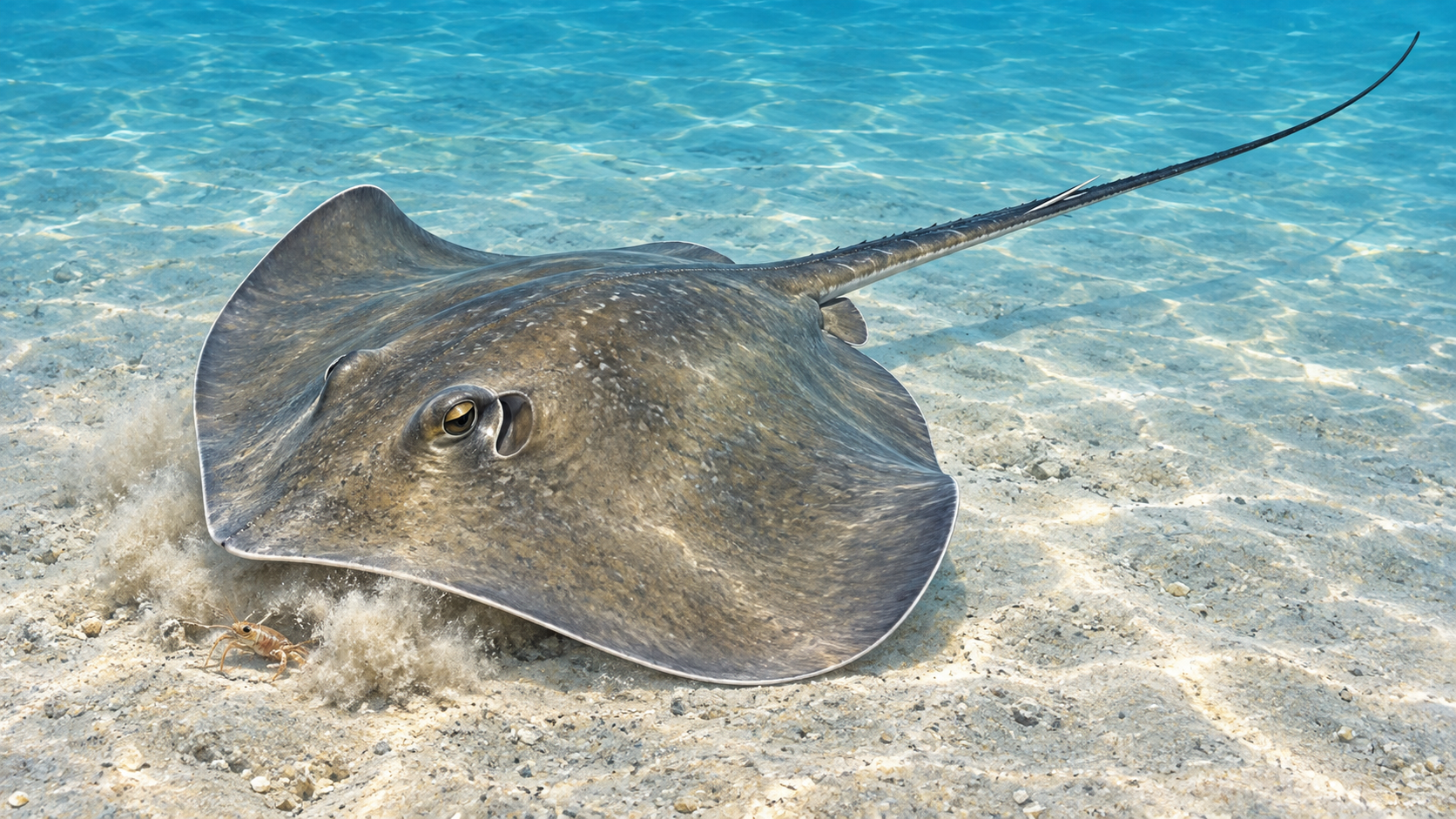
- Southern stingray: the first photograph on Florida Museum’s Southern Stingray page, credited to Jason Romine. Describe its broad, flattened body and long tail.
- Clearnose skate: the first photograph under “Biology” on Florida Museum’s Clearnose Skate page, credited to the Virginia Institute of Marine Science. Describe the flattened body, pointed snout and tail. This photograph shows the animal out of water; it does not show feeding behavior. Use this third animal with Grades 6–8.
Without a projected image: read the feature descriptions aloud and let students compare those descriptions. Change “I can see” to “The description tells me.” A teacher sketch can clarify the words, but is not a direct observation of a real animal. The feeding readings and handouts do not require student internet access.
35 minutes
Grades K–2: Two rays, two places to find food
Question: Do two kinds of rays find food in the same way? Children compare a giant manta ray with a southern stingray, draw one in its feeding setting and explain a detail from a short read-aloud.
Read aloud
Giant manta ray. It swims through ocean water. When it feeds, it takes in tiny animals drifting in the water.
Southern stingray. It often moves along a sandy sea bottom. Its wide fins can stir the sand and uncover small animals or fish to eat.
Drifting means moving along in the water. The sea bottom is the ground under the sea. These are two examples, not descriptions of every ray.
Sources: NOAA Fisheries: Giant Manta Ray; Florida Museum: Southern Stingray.
- Notice (5 minutes). Show labeled images side by side. Ask what children can see; do not ask them to guess a diet from a still picture.
- Listen (8 minutes). Read the two descriptions, pointing to open water and sandy bottom on a simple sketch.
- Match (7 minutes). Match each animal to “food drifting in water” or “food uncovered at a sandy bottom,” and ask how children know.
- Draw (10 minutes). Each child draws one ray and where it finds food. An adult can record the child's spoken explanation.
- Explain and revise (5 minutes). Partners find the food or setting in each drawing and ask for a clarifying mark or word if needed.
Look for: A child names or points to the chosen animal and connects it to the appropriate feeding setting. Spelling and drawing detail are not assessed.
Print the Grades K–2 student page. Read the animal names aloud and offer the two setting labels before children draw.
45 minutes
Grades 3–5: Compare two ways of finding food
Question: How can two rays have different ways of finding food? Students separate observations in labeled images from facts in short source cards, then create a two-panel illustration.
Source cards
A. Giant manta ray. It filters tiny drifting animals from water while swimming. Two flexible parts near its mouth help guide water and food toward the opening.
B. Southern stingray. It often lives near sandy or silty bottoms in shallow coastal water. Its broad fins can stir sand and uncover prey such as small fish, crabs or shrimp.
Filter means separate food from water. The seabed is the bottom of the sea. These cards describe the named species, not every ray.
Sources: A — NOAA Fisheries: Giant Manta Ray; B — Florida Museum: Southern Stingray.
- Look before reading (5 minutes). Record “I can see” and “I need a source to know.” Use the reference-photo descriptions if an image cannot be displayed, and identify them as descriptions.
- Read (8 minutes). Underline one feeding fact in each source card and compare the two situations.
- Sort and test (10 minutes). Use the three statements on handout page 1. Ask whether each comes from the picture, reading or both. Model the manta feeding statement: card A supplies it; a still photograph does not show the whole feeding behavior. Then test “All rays feed alike.” The cards give a difference, so they contradict it. Ask whether the cards tell us how many rays exist: that is unanswered, not contradicted.
- Draw (15 minutes). Use the two labeled panels on handout page 2, one per animal. Show a plausible feeding setting and one source-supported annotation.
- Check (7 minutes). A partner asks which source supports the explanation; the artist revises one label, arrow or sentence.
Look for: A source-supported difference between the species and a distinction between seeing a feature and learning a feeding fact.
Teacher check: Broad fins may be observed in a clear photograph and are also described in card B for the stingray. Accept “both” when the student points to matching evidence. The two feeding statements come from the reading. Do not require a single category when both apply. Read aloud, offer animal-name labels or accept dictated captions as needed.
55 minutes
Grades 6–8: Test a claim about rays
Question: What can evidence about giant manta rays tell us—and what can it not tell us about all rays? Students compare the manta and southern stingray with a related clearnose skate, then design an illustrated field card.
Evidence cards
A. Giant manta ray. It filters small drifting animals from water while swimming. Two flexible parts near its mouth help guide water and food inward.
B. Southern stingray. It can stir sand with its broad fins and uncover prey, including small fish and crustaceans, at the seabed.
C. Clearnose skate. This relative of the two rays is a skate, not a stingray. It eats mollusks, shrimp, crabs and small fish, and lays eggs in cases. A similar prey list does not establish identical feeding behavior.
D. A threat and a limit. NOAA identifies commercial fishing as a main threat to giant manta rays. They may be targeted or caught while fishers seek other species; the latter is called bycatch. NOAA says their global population size is unknown. This assessment does not establish the status of every ray or skate.
Sources: A and D — NOAA Fisheries; B — Florida Museum: Southern Stingray; C — Florida Museum: Clearnose Skate.
- Describe and classify (6 minutes). View three labeled animals. Identify what pictures cannot show about diet or population trends.
- Compare (9 minutes). Use the worked manta row on handout page 1, then complete the stingray and skate rows with a feeding detail and source.
- Test the theme (13 minutes). “Our Vanishing Rays” invites a question; it is not evidence about every species. Model the first statement below using card D, then let pairs classify the others on handout page 2. Rewrite the overbroad statement to name the species and threat the card actually covers.
- Create (17 minutes). On handout page 3, draw a museum-style giant manta field card with a feeding fact, qualified threat statement, source credit and one unknown.
- Revise (10 minutes). Partners identify an overbroad claim or image and revise it to fit the evidence. Ask what source would be needed to assess a different species.
For each statement, choose supported, contradicted or not established by these cards. Name the card and explain why. “Not established” means the cards do not settle the question; it does not mean false.
- Fishing can threaten giant manta rays.
- Some giant manta rays are caught while fishers seek other species.
- Every ray and skate is disappearing.
- We know exactly how many giant manta rays live worldwide.
Teacher check: Statements 1 and 2 are supported by D; 3 is not established; 4 contradicts D. “Unknown” does not mean safe or extinct. A narrower replacement for 3 is “NOAA identifies commercial fishing as a threat to giant manta rays.” Read card D aloud and model a classification when students need support.
Look for: A claim that names giant mantas specifically and recognizes what remains unknown.
Two 45-minute sessions
Grades 9–12: Make an evidence-based visual argument
Question: What can we responsibly say about giant manta rays when evidence of threats, distribution and population size is incomplete? Students distinguish a documented threat from a regional model prediction and make an annotated exhibit panel.
Two sources with different purposes
A. Species account. NOAA identifies commercial fishing as a main threat to giant manta rays. Some are caught deliberately; others are bycatch, caught while fishers seek other species. Their global population size is unknown. This is a species-specific threat assessment, not a claim about all rays.
B. Distribution research. A NOAA research summary describes more than 5,000 verified sightings gathered from surveys and other reports. Records were concentrated where people were more likely to see mantas. Researchers accounted for aerial survey effort and viewing conditions in a model of likely occurrence in eastern U.S. and Gulf waters. For example, the model predicts high nearshore occurrence off northeastern Florida in April. Sightings can include repeat observations; they are not a count of distinct animals. A regional prediction is not a global population estimate.
Terms: a distribution model uses observations and other information to estimate where an animal is likely to occur. Survey effort describes how much searching was done. A prediction is a model's expectation, not a promise of a sighting. Accounting for uneven observations improves a model; it does not remove every uncertainty.
A — NOAA Fisheries: Giant Manta Ray. B — NOAA Fisheries: Where Giant Manta Rays Go and Why (2022).
Session 1: Read the evidence and set a claim
- Question the historical theme (6 minutes). Ask which species, place and period “vanishing” would need to specify.
- Annotate (12 minutes). Read the briefs and definitions together. Find one threat, one distribution statement and one uncertainty. Discuss why a sighting record is not necessarily a different animal.
- Build an evidence ledger (17 minutes). Model the worked threat entry on handout page 2. Then classify the Florida/April statement from B as a model prediction and explain why it is not a guaranteed sighting. Complete the remaining entries, naming a source and limit. Ask how uneven searching could affect the records and what the researchers did about it.
- Write an exhibit claim (10 minutes). Draft one supported sentence and another naming its limit or an unanswered question. Check it against the ledger before creating the panel.
Session 2: Make and test the visual argument
- Recheck scope (5 minutes). Mark the words that specify giant mantas and the study region.
- Plan (10 minutes). Sketch a panel with labels for documented threat, model prediction and what remains unknown.
- Build (20 minutes). Create a legible draft with an original drawing, source credits and a visible qualification.
- Peer-audit (10 minutes). Ask whether an image or caption claims more than the sources support; revise one element and explain why.
Look for: A species-specific claim, a clear distinction between sightings and prediction, and an explicit limit.
Teacher check: A worked ledger row reads “Fishing threatens giant manta rays | A, NOAA species account | documented threat | not an assessment of all rays.” The Florida/April statement belongs to B and is a regional model prediction. More than 5,000 sightings does not establish 5,000 different living mantas. Unknown global population size is a stated uncertainty, not a numerical estimate. Let students explain the categories aloud before writing. Those ready for more can inspect the linked research summary, but no new model calculation is required.